

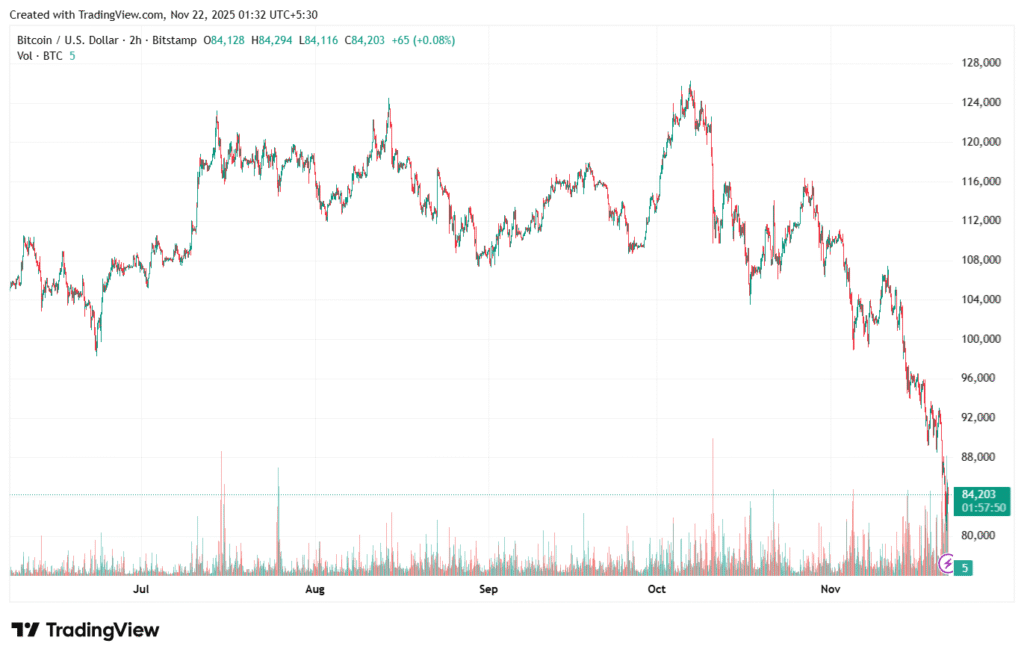
Bitcoin tumbled to a seven-month low on Friday, sinking into the $80,000 range as a broader crypto sell-off erased roughly $1 trillion of market value over recent weeks. Reuters reported Bitcoin trading as low as $80,553 during Friday’s session.
The rout followed a cascade of leveraged liquidations and a sharp retreat in investor risk appetite that hit digital assets and a broader swathe of speculative technology stocks. Market trackers and crypto publications recorded sizable short-term liquidations that intensified downward pressure.
Institutional buyer doubles down amid the rout
In the most concrete sign of institutional conviction, corporate treasury specialist Strategy disclosed in an 8-K that it bought 8,178 Bitcoin during Nov. 10 -16 at an average price of about $102,171 per coin, bringing its total holdings to 649,870 BTC. The company said the purchase was funded largely via recent preferred-stock issuance.
The disclosure underscores a growing split in the market between long-horizon institutional accumulators and short-term leveraged traders who have been forced to liquidate.
Why the Bitcoin collapse accelerated
Market participants and analysts point to several proximate causes:
- Leverage unwind: A wave of margin calls and derivatives liquidations accelerated the decline as Bitcoin breached key support levels. Crypto-market trackers reported large, concentrated liquidations over recent days.
- Risk aversion: Investors rotated out of high-beta assets as tech valuations cooled and hopes for near-term U.S. rate cuts dimmed, removing a key source of bid for speculative assets.
- ETF and liquidity dynamics: Outflows from some spot-Bitcoin ETFs and thinner liquidity in derivatives markets reduced natural buying interest during downturns, amplifying price moves. (Reported across market briefs.)
Analysis: Resilience on the buy side, fragility on the sell side
The episode reveals two converging dynamics. First, Bitcoin’s behaviour is increasingly tied to macro and equity market sentiment; it no longer trades in isolation as a niche retail speculation. Reuters and other outlets noted stronger correlation with risk assets in the latest pullback.
Second, the market structure remains fragile. Heavy leverage in derivatives and episodic ETF flows mean that corrections can be sharp and deep even after a sustained rally. CoinDesk’s liquidation readouts and market-data trackers show how a relatively modest price break can trigger outsized forced selling.
That said, Strategy’s sizable buy, disclosed in a public 8-K , signals a category of institutional participants willing to accumulate amid price dislocations. Whether those purchases form a durable floor or are simply tactical rests for large holders will be a key determinant of the path forward.
What to watch next
- Support levels: Stabilization above $80,000 would be a constructive near-term signal; sustained trading below that level could invite further technical selling.
- Institutional flows: Continued large purchases by public companies or ETFs could provide bid-side support and reduce volatility.
- Macro catalysts: Any change in U.S. monetary policy expectations or renewed stress in tech equities will likely drive the next leg of crypto’s direction.